
 Scripture Reference:
Acts 9:36-43
Suggested Emphasis:
God cares for people in need. We can help those in need.
Memory Verse: “When we have the opportunity to help anyone, we should do it. But we should give special attention to those who are in the family of believers.” Galatians 6:10, ICB




Story Overview:
Dorcas (or Tabitha) was a woman who “was always doing good and helping the poor” in her city of Joppa. When she died, everyone was very sad, and they called Peter to come to her house. When Peter arrived, all the widows were crying and showing him the clothing that Dorcas had made for them. Peter sent all of them out of the room and then, by the power of God, made Dorcas come back to life.
Background Study:
Click here for an overview of the Book of Acts
The last time we read about Peter in the Book of Acts was when he and John were preaching in Samaritan villages after rebuking Simon the Sorcerer and saying goodbye to Philip. Although based in Jerusalem, he must have travelled to various places to share the Good News of Jesus Christ.
Previous to today’s story, we find that Peter was visiting followers of Jesus and performing at least one miracle of healing in the town of Lydda, just over 47 kilometres (30 miles) northwest of Jerusalem (Acts 9:32-35). Lydda is the modern-day city of Lod.
Today’s lesson is a good opportunity to teach children the definitions of “disciple” and “apostle”. A disciple is someone who follows something or someone. In the book of Acts, we learn about the disciples of Jesus (those who follow Jesus).
Some disciples were also called apostles. An apostle is someone who is sent with a special mission or job. The Bible sometimes uses this word generally, but we are more likely to read specifically about the 12 Apostles of Jesus. Jesus chose the 12 Apostles during His ministry (see the story Naming the 12 Apostles). In Acts 2, we learn they were given the power to perform miracles and help people understand that the news about Jesus was true (see the story Sermon at Pentecost).
Paul was also an Apostle (Galatians 1:1). Jesus appeared to him later, after His death and resurrection, and called him to a special mission. (Saul (Paul) Becomes a Christian.
The town of Joppa (modern-day Jaffa, part of Tel Aviv) is another 20 kilometres (just over 12 miles) north-west of Lydda and is on the coast. A church had already been established in Joppa by this time, and one of the beloved disciples there was a woman named Tabitha. The Aramaic name “Tabitha” is translated as “Dorcas” in Greek.
 The church’s love for this woman is seen in the way they mourned her when she became ill and subsequently died. When the church members in Joppa heard that Peter was nearby, in Lydda, two men were sent there to urge him to return with them to Joppa. The seeming expectation that Peter might raise her from the dead speaks volumes about the understanding of these disciples that the Holy Spirit was active in the work of the apostles.
Interestingly, these two men urged Peter to “Please come at once!” (Acts 9:38). Emotions were running very high back in Joppa, with all the widows weeping and mourning over Dorcas. Perhaps this was the urgency.
Or perhaps they wanted Peter to come quickly so he could arrive before the burial. It was a common custom to wash a dead person’s body and place it in an upper room of a house. In Jerusalem, the custom of burying a body the same day as the person died was more strictly adhered to than in these outlying regions. Even so, bodies would be buried fairly soon after death.
When Peter arrived in the upstairs room at this house in Joppa, he was greeted by the touching scene of widows reminiscing about the robes and other clothing that Dorcas had made while she was alive. This is understandable, and for centuries, women worldwide have treasured the handmade items left behind by loved ones who have passed away. These women wanted Peter to see these and understand what a wonderful woman Dorcas had been to those around her.
There seems to be no better epitaph than to say, “She was always doing good and helping the poor.” (Acts 9:36). In another place in the New Testament, James speaks of the care for orphans and widows as “true religion” (James 1:27). Dorcas practised true religion.
Peter had been with Jesus when Jesus raised Jairus’ daughter, and he asked this crowd to leave the room like Jesus had. Peter knelt to pray, then turned to Dorcas and said, “Tabitha, get up.” It is easy to picture the scene that the bible describes when she opened her eyes and looked at him. Peter held her hand and helped her to her feet before calling everyone back into the room. What a celebration there must have been!
After raising Dorcas from the dead, Peter spent some time in Joppa and stayed with a tanner named Simon, who lived by the sea. According to Jewish law, tanners would have been ceremonially unclean much of the time since they were working with the hides of dead animals. Staying at this man’s house was another indication that Peter was coming to terms with the fact the gospel was not simply meant for Jews. Earlier, when Peter preached the Sermon at Pentecost, he spoke of salvation and the Holy Spirit and announced,
“This promise is for you. It is also for your children and for all who are far away. It is for everyone the Lord our God calls to himself.” Acts 2:39, ICB
In the time since that sermon, Peter had gone on to preach to Samaritans (see the story, Simon the Sorcerer) and then made his way out of Jerusalem to this coastal town of Joppa, where he was willing to stay in a house where a strict Jew would never stay. Later, Peter will be here, at Simon Tanner’s house, when he has a vision that will cause him to obey the Lord, break another huge barrier, and preach the gospel to a Gentile (see the story, Cornelius Becomes a Christian).



Way to Introduce the Story:
Collect a spool of thread, a needle, and a container of straight pins. Show the spool of thread and the needle. Explain that these are used to make or mend clothes. Show the container of straight pins. Explain that sewers usually use straight pins to hold the material together. “One company that made straight pins was called the ‘Dorcas Company.’ They chose this name for a very special reason. Can anyone guess why? The book of Acts tells us about a woman named Dorcas. Let’s see if we can learn what her name has to do with sewing.”
top
The Story:
A disciple is someone who follows something or someone. In the book of Acts, we learn about the Disciples of Jesus (those who follow Jesus).
Some disciples were also called apostles. An apostle is someone who is sent with a special mission or job. In other stories, we learned about the Apostles of Jesus. First, there were twelve, and later, there were thirteen. Jesus chose these men to do the special job of telling people the Good News about Him. They were given the power to perform miracles and help people understand that the news was true. One of the Apostles was Peter, and he travelled to many places, teaching about Jesus and helping people learn to be disciples and follow Jesus.
While visiting disciples in the town of Lydda, the Apostle Peter met Aeneas, who had been unable to walk for eight years. When Peter saw him, he told Aeneas, “Jesus Christ heals you. Get up and take care of your mat.” Everyone was amazed when Aeneas immediately got up and walked! Now, they knew that the good news about Jesus was true. They wanted to be disciples of Jesus too.
Meanwhile, in the nearby town of Joppa, some more men and women followed Jesus. One of these women was Tabitha. In the Greek language, her name was Dorcas. The Bible says, “Dorcas was always doing good and helping the poor.” Sometimes, she sewed and made clothes for people.
Joppa’s disciples were very sad when Dorcas became sick and died. They washed her body and put her in an upstairs room to wait until she was buried. When the disciples in Joppa heard that Peter was in the nearby town of Lydda, they sent two men to get him to come to Joppa.
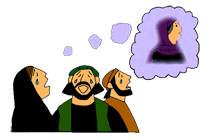
When Peter arrived at Joppa, he went to the upstairs room. Everyone was crying and showing him some of the robes and other clothing that Dorcas had made when she was alive. All the people missed her because they knew that Dorcas had been a kind person who cared for people in need.
Peter knew it was time to show everyone that the good news of Jesus was true. He asked everyone to leave the room, knelt, and prayed. After he prayed, Peter turned to the dead woman and said, “Tabitha, get up.” The woman opened her eyes, and when she saw Peter, she sat up. Peter took her hand and helped her to her feet.
When Peter called the rest of the disciples back into the room, they were so happy to see Dorcas alive again. This was a miracle! God’s power could heal people and even raise them from the dead. God loves to heal and help people.
Peter continued to stay in Joppa at the house of a man called Simon. Many more people in Joppa learned about what had happened, and they became disciples, too. The church became bigger every day.
God cares for people in need and wants to provide for them. He looks out for them through people like Dorcas, who helped many people in Joppa through her good deeds and kindness. How could you care for people in need? How can you be like Dorcas and help others?
Ways to Tell the Story:
This story can be told using a variety of methods. Always remain true to the facts found in the Bible but help children connect to its meaning by using drama, visual aids, voice inflection or other group participation.
Click here for visual aids and story-telling methods.
Click here to download the slideshow, or click here to download the pictures to print.
Each teacher is unique, so only use the illustrations that best relate to how YOU tell the story in THIS lesson. Too many illustrations can be confusing, so eliminate any that cover other stories or details you do not wish to emphasise in this lesson.
top
Review and Reflection Questions:
Review questions help children remember and know the facts of a story, while reflection questions encourage them to internalize its meaning and implications for their lives. Asking at least one of each type of question can help strengthen a child’s spiritual development and help them connect to God. Click here to learn more about review and reflection questions.
Review:
- What is another name for Dorcas? (Tabitha)
- Where did Dorcas live? (Joppa)
- What did Dorcas do to help the widows in her town? (She sewed clothes for them)
- When Dorcas died, what did her friends do? (They asked Peter to help. They also cried and showed Peter all the clothes Dorcas had made for them)
- What did Peter do first when he saw that Dorcas was dead? (He kneeled and prayed)
- What did Peter do after praying for Dorcas? (He told her to stand up, and by the power of God, Dorcas was made alive again)
- Who heard about Dorcas being brought to life again? (People everywhere in Joppa)
- What other miracles of people being raised from the dead do you remember from the Bible?
- What does this story show you about God?
- What does this story show you about people?
Reflection:
- What colors or designs do you think the clothes Dorcas sewed could have had?
- How old do you think Dorcas might have been?
- What question do you have for God about this story?
- If you were one of the people Dorcas made clothes for, how would you feel when she died?
- Why do you think it was important for Peter to pray before telling Dorcas to stand up?
- How do you think Dorcas’s body felt when she was brought back to life?
- How do you think the people mourning Dorcus felt when she was brought to life?
- What kind of things do you think Dorcas did to help the poor? What good things might she have done?
- Is there someone you know who is always serving and helping the poor?
- Has someone ever helped you or your family when you were in need? (Ex: help with moving, during sickness, etc.)
- Is there a way you want to help people? (Suggestion: consider doing a service project with the children or your church based on the children’s responses)
Prayer:
It is important to guide children in learning how to pray. In prayer, children can connect with God and learn that He hears and answers them. God can become a life-long friend who is with them every moment of their lives. Try using a variety of prayer methods from time to time so that the children can learn to connect with God in different ways. Note that you can pray at any time throughout your lesson. A variety of prayer methods are found here.
Song Suggestions:
- I’ve Got Peace Like a River Song
- Love is Something If You Give It Away Song
- L-O-V-E Song
- This Little Light of Mine Song
- Refer to the Song Page on this website for more options.
Activities and Crafts:
(How to choose the best learning activities for my teaching situation)
Activities:
- If your congregation has a clothing room for benevolence, take a tour and speak to those who run it.
- Try one of these Memory Verse Activities to help the children learn a memory verse. An appropriate memory verse might be, “When we have the opportunity to help anyone, we should do it. But we should give special attention to those who are in the family of believers.” Galatians 6:10, ICB
- Arrange for children to bring clothing donations for the next week. If your church does not already have a method for donating clothes, find out about agencies that take donations in your community.
- Place several items in a bag or pillow case (bible, blanket, toy, tin of food, etc.). Let the children take turns pulling one item out of the bag. When they have chosen an item, they can tell the other children how it can help someone in need.
- Have children “make” clothing and conduct a “fashion show”. As you tell the story, they use pretzel sticks, icing, and lollies or fruit to make people and clothe them as Dorcas did. This activity would work well for mixed-age groups. I picked up this idea from a STAMP (Short-term Australian Missions) student in 2012. Dorcas Raised from the Dead Lesson Plan
- Sing the Potato Chip Song
 Invite the children to respond to this story using the adaptable “God’s Story” printable reflection page. Free printables for this story.
Crafts:
- If you can arrange it, have the children learn to sew something simple. Maybe you know someone who could help you with this. Perhaps even sewing buttons in the shape of a cross would be a simple way to experience this story.
 Print bookmarks, trading cards or timelines (printable pages).
- Visit the Teaching Ideas page for additional activities and crafts.
Other Online Resources:
- Colouring page and puzzle worksheets (Tabitha is another name for Dorcas) (Calvary curriculum)
- Colouring page (Raising our kids)
- Script for the story (Kids Corner)
- Lesson Plan (Tumct)
https://www.pinterest.nz/marynnz/acts-beyond-jerusalem/
Map attribution: The map above was accessed through freebibleimages.org. It is the copyright of Chris and Jenifer Taylor of The Bible Journey (www.thebiblejourney.org), who have granted FreeBibleimages permission to distribute them using a Creative Commons Attribution-NonCommercial 4.0 International License. Arrows and numbers altered.
top
©Mission Bible Class 2011-2025. Before copying or reproducing any portion of this website, please carefully read the “Copyrights and Permissions Page.” https://missionbibleclass.org/about/copyrights-and-permissions/ (Not to be sold or profited from in any way.) www.missionbibleclass.org