
 Scripture Reference:
Acts 17:1-15
Suggested Emphasis:
God loves when we are curious about Him and the faith. He gave us the Bible to explore the truth about who He is and how to follow Jesus.
Memory Verse:
“All Scripture is inspired by God and is useful for teaching and for showing people what is wrong in their lives. It is useful for correcting faults and teaching how to live right.” 2 Timothy 3:16, ICB




Story Overview:
Paul continued his 2nd Missionary Journey and visited the cities of Thessalonica and Berea. Some people began to follow Jesus in Thessalonica, but others were jealous and caused trouble. Paul went on to Berea, where the people received the message of Jesus with great eagerness. They examined the Scriptures daily to see if Paul’s words were true. Troublemakers from Thessalonica soon followed and caused so much trouble that the Christians escorted Paul to Athens for his safety.
Background Study:
Click here for an overview of the Book of Acts

This lesson is a continuation of Paul’s 2nd missionary journey. The journey had begun with Paul and Silas setting off from Antioch and travelling across Asia Minor, re-visiting the churches that Paul and Barnabas had established during their 1st journey.
Paul’s travelling companions were now Silas, Timothy and Luke.
The opposition from the Jewish leaders in Thessalonica sets the scene for what happens to Paul and his group when they teach in Berea. When Paul compares the Jews in these two places, he regards the Berean Jews as better.
Prior to his arrival in Thessalonica, Paul was in Philippi. Two important events had happened there:
From Philippi, Paul would have travelled on the Roman road system called the Via Egnacia. This was the 1,120-kilometre (696-mile) Roman road system that connected a string of Roman colonies from the Adriatic Sea to the Bosphorus. Like other major Roman roads, it was about six metres (19.6 ft) wide, paved with large polygonal stone slabs or covered with a hard layer of sand. (information about the Via Egnacia has been taken from http://en.wikipedia.org/wiki/Via_Egnatia).
First, in Thessalonica (Acts 17:1-9):
This brought Paul and his companions to the port city of Thessalonica, now the modern-day city of Thessaloniki, Greece. Thessalonica had a synagogue and Jewish community. Just as he had done many times before, Paul begins his mission work in the city by first visiting the synagogue.
Some of the Jewish leaders were jealous when members of their synagogue and even people from the community believed the Good News and became followers of Jesus. They were angry and convinced people of bad character to form a mob and riot. When they could not find Paul, the mob dragged a man named Jason in front of the city officials and said Jason had allowed Paul to stay at his house. The group falsely accused Jason of the high Roman offence of treason. To them, there was only one king, Caesar, so they said it was treason when Paul preached that Jesus was the King over everyone.
Jason and other believers had to pay fines, but Paul and Silas left the city that night and travelled to Berea.
Thessalonica features later in the New Testament. The church grew and became established in Thessalonica. Paul would later write letters to them, and the letters, 1 Thessalonians and 2 Thessalonians, form part of the New Testament.
Next in Berea (Acts 17:10-15):
The city of Berea is now known as Veria, Greece, and it is 73 kilometres (just over 45 miles) west-southwest of Thessaloniki.
Again, Paul and Silas begin their visit with a trip to the local synagogue. The only Scriptures Paul and Silas would have used would have been those of the Old Testament. The documents that would make up the New Testament had not yet been written. But Paul knew that Jesus had been prophesied about throughout the Old Testament. The Jews were awaiting a Messiah. God was fulfilling his promises through the Jewish nation, so speaking to Jews was the right place to begin.
The writer of Acts points out that the Bereans were of more noble character than the Thessalonians. They were called noble because
- They received the message with great eagerness.
- They examined the Scriptures daily to see if what Paul said was true.
The Jews that had caused so much trouble in Thessalonica heard about Paul’s success in Berea. They travelled over to Berea for the express purpose of stirring up trouble. This action confirms Paul’s statement about their lack of noble character.
Again, Christians stepped in to protect these missionaries. Silas and Timothy stayed in Berea while Paul was sent to the coast. This either meant he would sail or follow the road along the coast to his next destination. The brothers escorted Paul to Athens, and arrangements were made for Silas and Timothy to join him as soon as possible.
Study of God’s Word
The noble people of Berea are a good example for us. With open minds and hearts, they were eager and open to what God had to say to them. But, at the same time, they were willing to study the Scripture to ensure that whatever a preacher said measured up to what God had said in His Word. Encourage children always to compare what they hear to what the Scripture says.
Other Bible References to the Importance of Scripture:



Way to Introduce the Story:
Lead the children in a fun activity that allows them to find verses in the Bible. Provide each child with a bible containing Old and New Testaments and lead the children in a “sword drill.” The name of this game comes from the Bible being referred to as a sword in Ephesians 6:17. In the activity, the leader brings the “soldiers” to attention and then calls out a bible verse (for example, John 3:16.) The winner of that round is the first to find and begin reading that verse out loud. Play a few rounds. Point out the importance of knowing how to search for scriptures in the bible.
You can then say, “In today’s story we will learn about people who studied God’s Word to learn who God is and how to follow Him.”
“Accept God’s salvation to be your helmet. And take the sword of the Spirit—that sword is the teaching of God.” Ephesians 6:17, ICB
The Story:
Paul’s second Missionary Journey began in Antioch. He and Silas travelled through Asia Minor, visiting the churches Paul helped establish on his 1st Journey. Then, they sailed across the Aegean Sea to teach people in Macedonia. These men travelled wherever God wanted them to teach people about Jesus.
One of the places where Paul and Silas preached was in the city of Thessalonica. There were many Jewish people in this city, and they often gathered together in their meeting place, called a “synagogue.” Since Paul was an educated Jewish teacher, he went to the synagogue to tell the other Jews about Jesus.
Long ago, in the Old Testament, God chose the Jewish people to be his nation and follow him. God would use the Jewish people to bless the world. A Messiah would come from this nation. He would be their king and the true king of the world. The Messiah would rescue the world from the power of sin and death.
Paul’s message for the Jewish people in the synagogue was that the Messiah had come and that the Messiah was Jesus. He had died on the cross but was raised alive again to reign as the world’s true King so that everyone could be saved from the power of sin and death.
Some Jews believed in Paul and decided to become followers of King Jesus. Other people in the city were not Jews but believed in God. When they heard about Jesus, they became followers, too. Even some important women in Thessalonica heard Paul speak and decided to become Christ-followers (Christians).
However, not all Jews believed what Paul was saying about Jesus. Some did not believe Jesus was the Messiah and did not want anyone else to believe it either. They were jealous that so many people were listening to Paul and Silas.
These were not nice people. They found some bad people in the town and got them to cause trouble and make everyone angry. They thought that Paul was staying at the home of a man named Jason, so they rushed to Jason’s house. Paul wasn’t there, but they dragged Jason out of his house and took him to the court officials.
Jason was innocent, but the men accused him and his friends of causing trouble in the city. Finally, the court officials told Jason he could return home if he paid them money and promised to stay out of trouble.
Thessalonica had become a dangerous place, so some Christians helped Paul and Silas leave the city that night. They sent them to the town of Berea.
When he arrived in Berea, Paul went to their synagogue to tell the Jewish people of Berea that Jesus was the Messiah. But when Paul spoke to them, he found they were very different from the people in Thessalonica. Luke writes that the Bereans were “more noble.”
A noble person has good personal qualities and is moral, as evidenced by their open mind and heart. The noble Bereans listened carefully to what Paul said and then studied the Scripture to learn more. They were curious about Jesus and wanted to read what God had to say about the Messiah. They knew the Scripture was true and wanted to make sure that everything Paul said agreed with God’s words.
And it did! Jesus was the Messiah. Jesus was the King of the whole world! Because of this, many of the Bereans in the synagogue decided to follow Jesus. As Paul and Silas continued to speak with people, many other people besides Jews became followers of Jesus, too.
Paul, Silas, and even their friend, Timothy, continued talking to people about Jesus in Berea. Meanwhile, the news got back to Thessalonica, and the angry Jews from there travelled to Berea to cause trouble. Soon, they convinced some people in Berea to be angry with Paul. Paul’s life was in danger.
Now Berea had become a dangerous place for Paul. But the Christians in Berea made sure he was safe. They took Paul to the coast and then escorted him down to Athens. They promised to send Silas and Timothy to him soon.
Paul remembered the noble Christians in Berea, but as he looked around at all of the idols in Athens, he knew that these people needed to hear about God and Jesus, too. There was still much work to do.
God loves when we are curious about Him and His ways. The Bereans eagerly read the Scriptures to discover if Jesus was really the messiah. Today, we can discover who God is and how to follow Jesus by reading the Bible, just like the Bereans.
top
Ways to Tell the Story:
This story can be told using a variety of methods. Always remain true to the facts found in the Bible but help children connect to its meaning by using drama, visual aids, voice inflection or other group participation.
Click here for visual aids and story-telling methods.
Click here to download the slideshow, or click here for the printable illustrations.
Be selective. Each teacher is unique, so only use the illustrations that best relate to how YOU tell the story in THIS lesson. Too many illustrations can be confusing, so eliminate any that cover other stories or details you do not wish to emphasise in this lesson.
Or use the video below.
Review and Reflection Questions:
Review questions help children remember and know the facts of a story, while reflection questions encourage them to internalize its meaning and implications for their lives. Asking at least one of each type of question can help strengthen a child’s spiritual development and help them connect to God. Click here to learn more about review and reflection questions.
Review:
- What is a synagogue? (The building where Jews met together to learn about God)
- What did Paul teach about at the Synagogue? (That Jesus was the Messiah the Jewish people had been waiting for)
- Who started a mob and attacked Jason’s house in Thessalonica? (Jews and troublemakers from the marketplace)
- Why did the Jews start a mob? (They were jealous when many Greeks joined Paul and Silas)
- Who did the mob drag to the authorities of the city? Why? (Jason and unnamed others were accused of saying there was a king other than the emperor. They said Jesus was king. Jason was also in trouble because he let Paul and Silas be guests in his home)
- What happened to Paul and Silas after the mob attacked Jason’s house? (The Christians sent them away to Beroea, where they went to the synagogue and preached that Jesus was the Messiah)
- Why are the Bereans said to be better than the Thessalonians? (They received the message about Jesus with great eagerness and examined the Scriptures every day to see if what Paul was preaching was true)
- What happened after the Jews from Thessalonica came to Beroea to cause trouble for Paul and Silas? (Some of the Christians went with Paul to Athens, and said they’d send Silas and Timothy to him as soon as possible)
- What does this story show you about God?
- What does this story show you about people?
Reflection:
- Why do you think the Jews felt jealous when they heard that Greeks and some Jews were joining Paul and Silas and wanting to follow Jesus? Why weren’t the Jews happy that others wanted to follow God?
- How do you think Jason felt when his house was attacked?
- If you were Jason, how would you feel about your house being attacked and being dragged to the authorities?
- If you were Paul and Silas, how would you feel about sharing the gospel after this happened in Thessalonica?
- The Jews who were jealous in Thessalonica went to Beroea just to cause trouble for Paul and the good news message. Why do you think they did this?
- The Bereans heard Paul’s message and studied the Scriptures to see if his message about Jesus was true. Do you believe the message about Jesus is true? Would you like to read the Bible with someone?
- Do you read the Bible with your family or by yourself? Do you like to read the Bible? Why or why not? Is there anything that frustrates you about reading the Bible?
- What question do you have for God about this story?
- What is something you wonder about in this story?
Prayer:
It is important to guide children in learning how to pray. In prayer, children can connect with God and learn that He hears and answers them. God can become a life-long friend who is with them every moment of their lives. Try using a variety of prayer methods from time to time so that the children can learn to connect with God in different ways. Note that you can pray at any time throughout your lesson. A variety of prayer methods are found here.
Song Suggestions:
- B-I-B-L-E
- Read Your Bible, Pray Every Day
- The Books of the New Testament.
- Refer to the Song Page on this website for more options.
Activities and Crafts:
(How to choose the best learning activities for my teaching situation)
Activities:
- Trace Paul’s Second Journey on a Map
- Ensure every child has a bible that contains both Old and New Testaments. Conduct a “sword drill” where you call out scriptures, and the children race to find them in their Bibles. (The name of this game comes from the Bible being referred to as a sword in Hebrews 4:12 and Ephesians 6:17).
- Be sure to spend extra time on today’s memory verse. You can work on it for the next few weeks. This is one the children need to know.
- Learn how to study the scripture like the Bereans. Older children can be introduced to bible dictionaries, concordances, atlases, and commentaries. You might visit the church library to see some available study material.
- Help the children to begin their bible dictionary. Please write down the new words they have learned this term and give some Scripture references.
- Object Lesson: Bring a food item or candy bar to class and place it in front of the children. Lay your bible beside it. Talk about how simply looking at the candy bar is not enough. It is not until we take it and eat it that we can enjoy it. The Bible is the same. Just carrying it around or looking at it is not enough. It is not until we read it that we can receive the benefits. Read a few Scriptures you have chosen beforehand. After discussing this with the children, let them enjoy the candy bar.
- To review, you or the children can draw a large outline of Paul on a whiteboard or piece of paper (even drawing with a stick in the sand works fine if you are outside). Then, after you have taught the lesson, ask the children to think about what they have just learned from the Bible. Have them write descriptive words or draw pictures inside and around the outlined illustration of Paul. When you see what the children are writing or drawing, you may be surprised or encouraged by what insights they have picked up from the story. This is also a good opportunity to correct or add to anything you might not have covered as well as you could have when you were teaching.

If you prefer, you can download and print the illustration of Paul provided here and then have the children write and draw on it for the review. - Alternatively, if you are teaching a series of lessons about Paul, you might outline his shape on a large poster or paper and then add descriptive words about him each time you study a new lesson.
- Click here for the 16 lessons about the Life of Paul grouped together.
 Invite the children to respond to this story using the adaptable “God’s Story” printable reflection page. Free printables for this story.
Crafts:
- Make a relief map of Paul’s Journeys featuring the place in today’s story. If you are studying Paul’s journeys over a few lessons, then you could add more details to the map each time you learn about another stop on the journey. Instructions on how to make a relief map at https://www.weirdunsocializedhomeschoolers.com/step-by-step-to-making-saltdough-map/
- Make a scroll. Click here for instructions. Write this verse on it: “Be a worker who is not ashamed of his work—a worker who uses the true teaching in the right way.” 2 Timothy 2:15, ICB.
 Print bookmarks, trading cards or timelines (printable pages).
- Visit the Teaching Ideas page for additional activities and crafts.
Other Online Resources:
- Worksheet: Wordsearch of Books of the New Testament (christiananswers.net)
- Map of Paul’s 2nd journey (deeperstudy.com)
- Review: Create a “passport” that covers Paul’s life. Good visual ideas and activities. It could be split up to go with several lessons or taught all together as a review of previous lessons concerning Paul found (kidsbibledebjackson.blogspot.co.nz)
https://www.pinterest.com/marynnz/paul-2nd-journey/
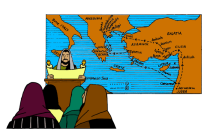
The map above is by Sweet Publishing and can be accessed through Free Bible Images.
You can download this and many other illustrations for free, if you agree to the generous Creative Commons terms, explained on their website.

©Mission Bible Class 2011-2026. Before copying or reproducing any portion of this website, please carefully read the “Copyrights and Permissions Page.” https://missionbibleclass.org/about/copyrights-and-permissions/ (Not to be sold or profited from in any way.) www.missionbibleclass.org